Reflect: When & How to Read the Bible
There are 24 hours in a day, and we spend about 8 of those asleep. We all have to eat, bathe, work, and interact with family, friends and coworkers. But how do you choose to spend your leisure time? How much time do you set aside for Bible reading?
Think of your most important relationships on Earth. Even when we’re far away from our loved ones, we text, email, make video calls day by day to stay close. When we don’t make the effort of regular contact, we lose touch, and the relationship gets rusty, unfamiliar. The same thing happens when we skip our daily fellowship with the Lord in His Word.
Did you know that there are 24 books in the Bible that you can read in 15 minutes? 40 that are readable in an hour? Take a look at this infographic that break down the Bible in various ways – by length, by book type, and by Testament – to see how you can read through the Bible in a way that fits your life.
Infographic: You Have More Time for Bible Reading than You Think | Crossway Articles
Consistency, commitment, and the quality of your attention means more than how much you read in a sitting. Daily, prayerful reading, even a few chapters each day, will help strengthen your relationship with the One Who means everything to us! Studies show that those who make Bible reading their first act of the morning are more likely to successfully establish a daily routine. Remembering that He is always with us, some even think of it as their morning coffee date with Jesus, giving Him the “firstfruits” of the day: the time we are freshest.
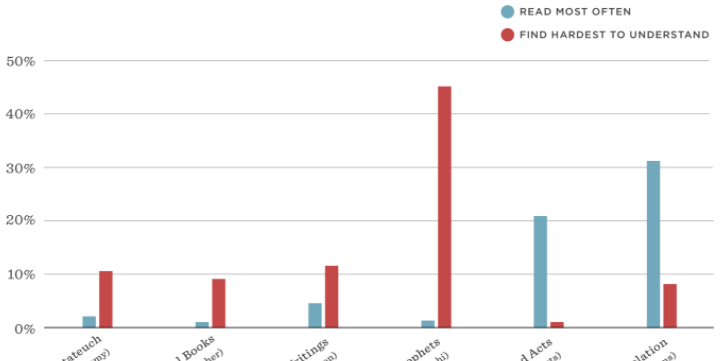
Having a hard time getting into some of the more difficult books? Keep reading for a few resources and approaches that are helpful in getting more out of your reading.
Tips for reading more deeply:
- Remember that Christ is the central figure of all Scripture, and His signposts and shadows within historical events speak to our own time as well, through what they reveal to us about God’s will through His unchanging nature and character.
- Use a tool like www.studylight.org/. You can search for words, phrases, and individual verses, to see where they are repeated throughout the Bible (concordances). You can also look at the original languages alongside various translations of a line, using the Interlinear Study Bible feature.
- Study with a commentary, which you can find at www.studylight.org/commentaries. A biblical commentary is a written systematic series of explanations and interpretations of Scripture. They are written by some of the most knowledgeable theologians in church history. Through a personal narrative, they provide deeper understanding and insight into the Bible.
- Mark your Bible / make notes regarding cross-references to other verses.
- Write questions and insights in a notebook as you read, or just afterwards. This can help you focus, as well as over time, so you can see how the Lord is growing your understanding and answering your questions. It may even fuel poetry or other God-inspired artwork, ministry ideas, and more!
- Particularly for verses you find confusing, read multiple translations of the verse (KJB, NIV, ESV, Berean, etc.). Bible Hub is good for this.
Infographic: How Do You Read the Bible? | Crossway Articles
See the Discipleship Study Resources section at the bottom of the Bulletin for a comprehensive list of reading plans and devotionals available online.
One final note: it also helps to discuss what you’re reading with a friend or Bible group. Check out our ConnectGroups for a group in your area. I’m also always happy to talk: email me at sarah.fitz@hif.vn.
Sarah Fitzsimmons